

Have you ever felt like your periods are getting heavier, longer, or just… harder to deal with? Maybe there’s that constant bloating, or a dull ache in your lower abdomen that just won’t go away.
You’re not alone—and more importantly, you’re not overthinking it.
For many women, these symptoms are quietly caused by uterine fibroids—a very common condition that often goes unnoticed until it starts affecting daily life. The good news? Fibroids are treatable, and with the right care, you can feel like yourself again.
Table of Contents
ToggleWhat Exactly Are Uterine Fibroids?
Let’s break it down in the simplest way possible.
- Uterine fibroids are non-cancerous (benign) growths that develop in or around the uterus.
- Think of them like small knots or lumps of muscle tissue that grow within the uterine wall.
- They can be as tiny as a seed or as large as a melon.
Quick Answers
- What are fibroids?
Non-cancerous growths in the uterus made of muscle tissue. - Are fibroids dangerous?
Usually no, but they can cause significant discomfort and complications if untreated. - Do fibroids turn into cancer?
Very rarely—less than 1% of cases.
Why Do Fibroids Develop?
Here’s the tricky part—there isn’t one single cause.
But research and clinical experience show a few strong connections:
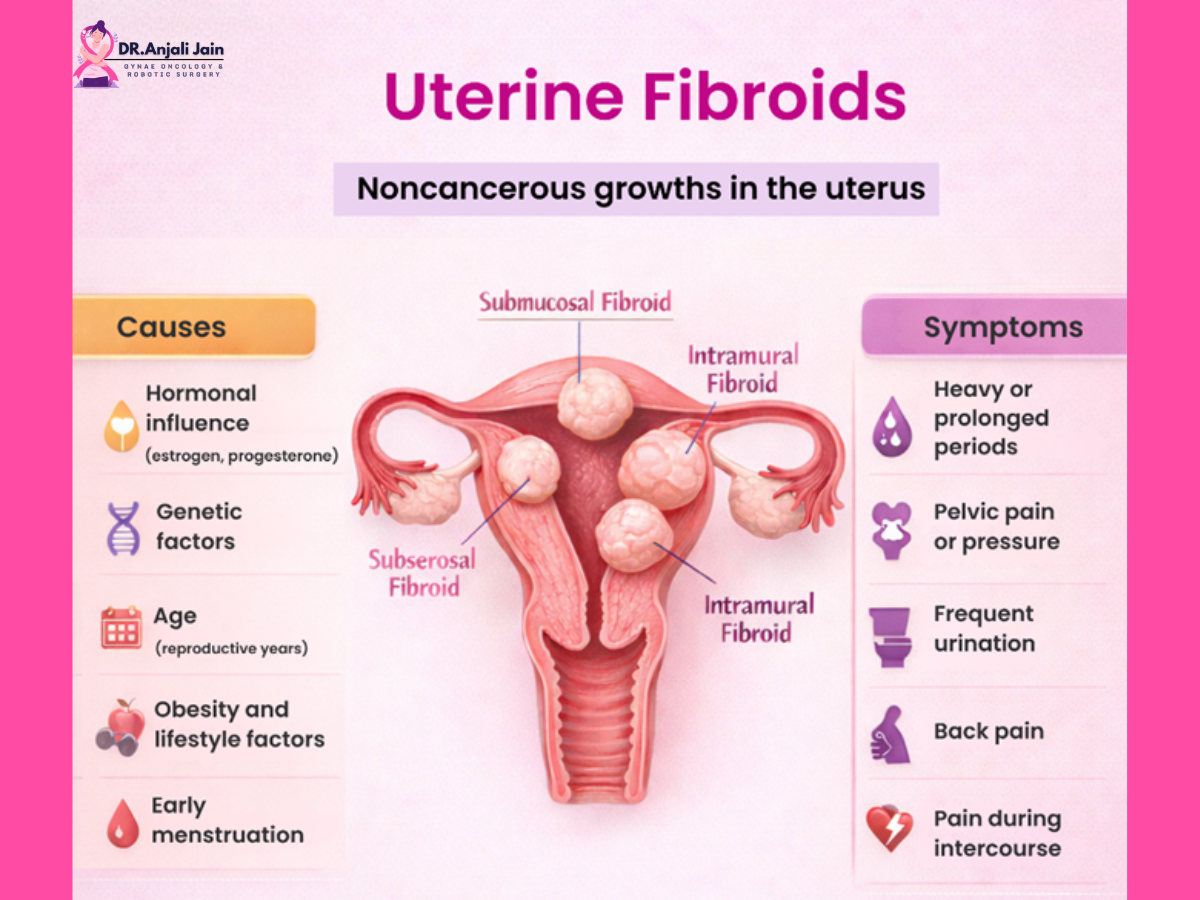
- Hormones (Estrogen & Progesterone): These hormones stimulate fibroid growth.
- Genetics: If your mother or sister had fibroids, your chances increase.
- Age Factor: Most common in women between 30–50 years.
- Lifestyle Influences: Obesity, diet, and stress can play a role.
Common Symptoms You Shouldn’t Ignore
Some women don’t feel anything at all. But for others, fibroids can seriously disrupt daily life.
Most Common Signs:
- Heavy menstrual bleeding (soaking pads quickly)
- Periods lasting more than 7 days
- Pelvic pain or pressure
- Frequent urination
- Bloating or enlarged abdomen
- Pain during intercourse
- Difficulty conceiving (in some cases)
Why Do These Symptoms Happen?
- Fibroids increase the surface area of the uterus → more bleeding
- They press on nearby organs → frequent urination or constipation
- Larger fibroids stretch the uterus → causing pain and heaviness
Types of Fibroids
Understanding the type helps decide the right treatment.
- Intramural Fibroids: Grow within the uterine wall (most common)
- Submucosal Fibroids: Grow inside the uterus → often cause heavy bleeding
- Subserosal Fibroids: Grow outside the uterus → may press on organs
- Pedunculated Fibroids: Attached by a stalk (like a mushroom)
When Should You See a Doctor?
Here’s a simple rule:
👉 If your periods are controlling your life instead of the other way around—it’s time.
Red Flags:
- Severe anemia (feeling tired, dizzy)
- Sudden increase in bleeding
- Persistent pelvic pain
- Trouble getting pregnant
Early diagnosis can prevent complications and open up less invasive treatment options.
How Are Fibroids Diagnosed?
Diagnosis is usually quick and painless.
- Ultrasound: First-line, simple imaging test
- MRI (in some cases): Gives detailed mapping
- Pelvic Exam: Helps detect enlarged uterus
👉 Many patients are surprised at how simple this step actually is.
Treatment Options: What Are Your Choices?
This is where things get encouraging—you have options, and treatment is highly personalized.
Treatment Depends On:
- Size and number of fibroids
- Symptoms severity
- Age and fertility goals
The Fix: Your Fibroid Treatment Roadmap
| Step | What Happens | Goal |
| 1 | Consultation & Diagnosis | Understand symptoms & fibroid type |
| 2 | Imaging (Ultrasound/MRI) | Accurate mapping |
| 3 | Personalized Plan | Based on lifestyle & future plans |
| 4 | Treatment | Medication or surgery |
| 5 | Recovery & Follow-up | Long-term relief |
Treatment Options Explained
1. Medications
- Help control symptoms like bleeding and pain
- Do not remove fibroids permanently
2. Minimally Invasive Procedures
- Laparoscopic Surgery (keyhole surgery)
- Robotic Surgery for precision
- Faster recovery, minimal scarring
3. Myomectomy (Fibroid Removal)
- Removes fibroids while preserving the uterus
- Ideal for women planning pregnancy
4. Hysterectomy (In Select Cases)
- Removal of uterus
- Considered when fibroids are large or recurrent
👉 The best treatment is not “one-size-fits-all”—it’s customized for YOU.
Meet the Expert
👩⚕️ Dr. Anjali Jain – Senior Consultant, Gynae Oncology & Robotic Surgery
With over 14 years of experience, Dr. Anjali Jain is a leading ESGO-certified Gynae Oncologist and Robotic Surgeon based in Gurugram.
She is known for her expertise in:
- Minimally invasive gynecologic surgeries
- Robotic-assisted procedures
- Advanced fibroid and cancer care
Trained at prestigious global institutions, Dr. Jain believes in a simple philosophy:
👉 “Every woman deserves treatment that is not just effective—but also comfortable, safe, and tailored to her life.”
Her approach combines advanced technology with compassionate care, ensuring faster recovery and better outcomes.
Patient Voice (Real Stories)
💬 “I thought heavy periods were normal until it became unbearable. Dr. Jain explained everything so calmly and treated my fibroids laparoscopically. Recovery was so quick—I wish I had come earlier.”
— Neha, 38
💬 “I was scared about surgery, but the robotic procedure was smooth and almost painless. Dr. Jain made me feel completely at ease.”
— Ritu, 42
💬 “After struggling with infertility, I discovered fibroids were the cause. Post-treatment, I finally conceived. Forever grateful!”
— Pooja, 34
Next Steps: Take Control of Your Health
📞 Ready to Talk to an Expert?
[Call Now Button]
👉 +91 95991 50155
[Book Appointment Button]
📅 Schedule your consultation today
📍 Visit Us
Medanta – The Medicity
Sector 38, Gurugram, Haryana, India
FAQs: Real Questions Women Ask
1. Can fibroids go away on their own?
Fibroids usually don’t disappear completely on their own, but they may shrink after menopause.
However, if symptoms are severe, medical treatment is often needed.
2. Are fibroids the reason for my heavy periods?
Yes, fibroids are one of the most common causes of heavy menstrual bleeding.
They increase the uterine lining surface, leading to more blood loss.
3. Can I get pregnant if I have fibroids?
Yes, many women with fibroids conceive successfully.
But depending on size and location, treatment may improve fertility.
4. Is surgery the only option for fibroids?
No, not always—treatment depends on symptoms and size.
Some cases can be managed with medication or monitoring.
5. Is fibroid surgery painful?
Modern techniques like laparoscopic and robotic surgery are minimally invasive and much less painful.
Recovery is faster compared to traditional surgery.
6. When should I worry about fibroids?
You should seek medical advice if symptoms affect your daily life.
Heavy bleeding, pain, or fertility issues are key signs to get checked.
Your body has a way of sending signals—it’s just that we sometimes get used to ignoring them.
If something feels off, it probably is worth checking.
And remember—fibroids are common, manageable, and treatable.
You don’t have to live with the discomfort.
Take that first step. Your future self will thank you.